
2nd October 2026
The Hawksmoor Vanbrugh Fund’s primary objective is to deliver a positive real return over rolling periods of at least 3 years. It aims to deliver this objective whilst also preserving capital in more difficult environments. Since its launch in 2009, Vanbrugh has categorically met the first objective, delivering inflation busting and sector leading returns. As the chart below demonstrates, despite this upside capture it has also protected capital well in risk off episodes, experiencing shallower drawdowns than MSCI World as well as the IA Mixed Investment 20-60% Shares Share sector in each of the major equity sell-offs of the past 17 or so years.
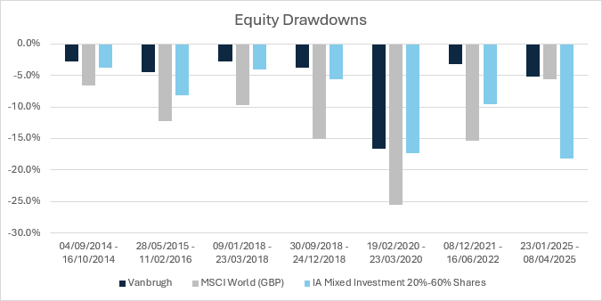
Source: FE Fundinfo 04/09/2014 to 08/04/2025
We remind investors of these return characteristics as context for some of the recent changes we have enacted in Vanbrugh, adjustments which we think should make the portfolio more resilient in a risk off episode. This includes a reduction in equity and private equity allocations, a renewed focus on high quality short-dated bonds within fixed income, profit taking in alternative real asset investment trusts, and a corresponding increase in investments that are less reliant on the direction of mainstream equity and bond markets.
This has been guided by evolving valuations as opposed to some big macro call. Our investors and regular readers may well recall our exuberance over the past couple of years regarding the potential upside in our portfolios. Wind the clock back and certain equity portfolios were trading on bargain basement valuations and many investment companies (IC) on generationally wide discounts to net asset value. From this starting point, Vanbrugh over the past 3 years has generated total returns of 37%, not bad going for a cautious managed fund. Whilst some of these returns have been driven by fundamentals, an element is explained by things becoming a bit more expensive. IC discounts have narrowed and even the cheapest of equity markets have seen earnings multiples move higher by a few turns. When prices go up, margin of safety and positive asymmetry compress. In short, it’s completely natural that valuation conscious investors such as ourselves should be trimming risk assets under these circumstances.
Equity exposure (excluding gold miners) today stands at 34% down from a peak of 46% in the Spring of 2024. The corollary of this has been an increase in ‘absolute return’ funds from zero a little over a year ago to almost 8% today. The focus here is very specific and crucially doesn’t involve swing the bat long-short managers where discerning margin of safety and patterns of return is nigh on impossible. Instead, the emphasis is on non-directional strategies that seek to exploit an inefficiency or market feature in a systematic and repeatable manner. Convertible Arbitrage is a case in point, a strategy with multiple components of return which employs a dynamic delta hedging strategy to monetise volatility. Returns have been delivered incrementally, within a narrow distribution and with low correlation to equity and bond markets. Our expectation is that these sorts of investments, whilst not necessarily acting as a hedge to equity risk, should be able to continue delivering positive returns in equity down markets.
Elsewhere we have introduced commodity exposure (see Dan’s note from earlier this year here) motivated in part by some of the asset class’s structural growth drivers (energy transition, AI infrastructure buildout, onshoring etc), but also by the diversification benefits commodities offer. Commodities have tended to perform well in higher inflation environments, episodes which often see positive equity-bond correlations, and as such can help improve the resilience of multi-asset portfolios in these sorts of regimes. In a world where supply side shocks seem to be occurring more regularly (geopolitics, weather), where the range of probable outcomes for inflation has broadened and where the risk of fiat debasement is high, dedicated exposure to hard assets like commodities seems a sensible allocation, supplementing our long-standing holding in physical gold that remains in place.
Increasing robustness isn’t all about alternatives. As discussed in May (Bonds can be dull but we’re even duller) Vanbrugh’s bond allocation is very defensively positioned at present, with limited interest rate and credit risk. Indeed, exposure to sovereign bonds at 17% has never been higher, whilst almost 80% of the Funds’ bond exposure is in AAA to A rated issues. The focus on shorter dated bond funds results in duration of less than 4 years, so significantly below that of the global bond market.
Bringing it all together, the chart below highlights how Vanbrugh’s asset allocation has evolved over the past 3 years.
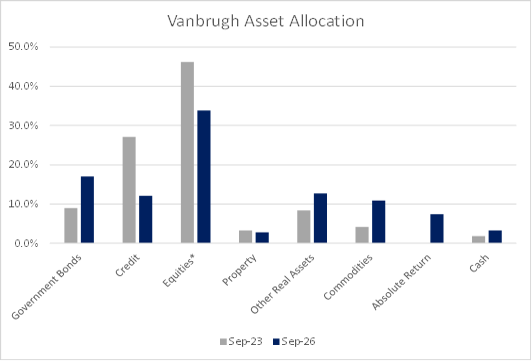
Source: Hawksmoor Investment Management 31/09/2023 to 28/09/2026
Despite adopting a more defensive posture, we remain confident in Vanbrugh’s ability to fulfil its prime objective of delivering positive returns after the impact of costs, taxes and inflation. Short-dated bond yields have risen to the point where they should deliver positive real returns and where it’s difficult from a yield breakeven perspective to envisage a scenario of negative total returns. Valuation dispersion within equities remains high and whilst most of our active funds trade on higher multiples than they did a few years ago, they still look decent value versus long term averages. Real asset investment trust discounts have tightened but share price implied portfolio returns from infrastructure and renewables continue to look attractive in both absolute and relative terms.
Given increased valuations and the reduced margin of safety this results in, we do though believe it prudent to have adjusted Vanbrugh’s positioning and to have introduced investments that make the portfolio more resilient in a broader range of possible outcomes. Whilst we don’t do predictions, we do recognise that rising valuations have occurred against a growing shopping list of macro concerns (AI earnings bubble, rising long-end yields, geopolitics) which adds further motivation to enhance the portfolio’s ability to protect capital.
When discussing the embedded value we see in our portfolios with investors it is vital to retain objectivity. Whilst we remain optimistic on Vanbrugh’s ability to capture upside, we are not banging the drum as hard as we were 2 or 3 years ago. It’s also important to remember that the capital preservation element of the mandate has been an important contributor to long-term total returns, helping the Fund compound from a higher base once market troughs are hit and recoveries begin. We’re not calling the timing of a sell-off and still have plenty of exposure to cheap risk assets, but feel comfortable embellishing Vanbrugh’s resilience which in turn will provide plenty of dry powder to deploy as and when equity and credit valuations become more compelling.
Ben Mackie – Senior Fund Manager

Subscribe to receive our latest commentary and insights straight to your inbox.
For professional advisers only. This article is issued by Hawksmoor Fund Managers which is a trading name of Hawksmoor Investment Management (“Hawksmoor”). Hawksmoor is authorised and regulated by the Financial Conduct Authority. Hawksmoor’s registered office is Sterling Court, 17 Dix’s Field, Exeter, Devon EX1 1QA. Company Number: 6307442. This document does not constitute an offer or invitation to any person, nor should its content be interpreted as investment or tax advice for which you should consult your financial adviser and/or accountant. The information and opinions it contains have been compiled or arrived at from sources believed to be reliable at the time and are given in good faith, but no representation is made as to their accuracy, completeness or correctness. Any opinion expressed in this document, whether in general or both on the performance of individual securities and in a wider economic context, represents the views of Hawksmoor at the time of preparation and may be subject to change. Past performance is not a guide to future performance. The value of an investment and any income from it can fall as well as rise as a result of market and currency fluctuations. You may not get back the amount you originally invested. FPC26774.
