
18th September 2026
Much has been written in the financial press recently highlighting the growth in Exchange Traded Funds (ETFs), and some articles even go so far as to use this to explain the recent shrinking of the investment company sector.
Here we look to point out the differences in the two structures; how they are two completely different wrappers, with different attributes, suitable for different assets and even different investors. ETFs are not substitutes for investment companies.
First, a quick health warning. The ETFs we discuss here are the common or garden variety: exchange-listed open-ended funds.
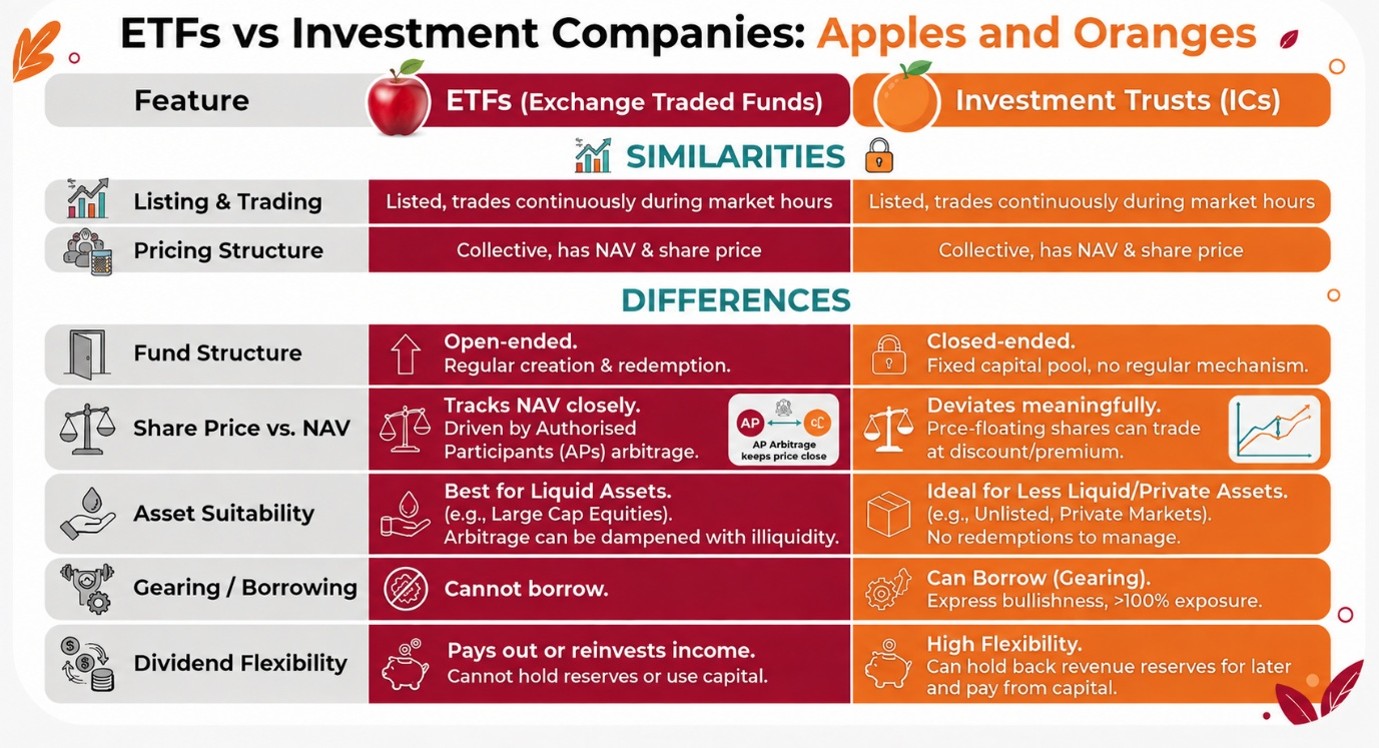
First, the two main similarities:
- They are both listed and trade continuously during market hours.
- They are both collectives with net asset values and share prices.
The differences are far more numerous and mainly stem from their structures. ETFs are investment products that hold a portfolio of assets – most often (but not always) listed equities. The ETF itself is listed like an equity, with shares bought and sold on an exchange. A key attraction is that the share price is meant to track the Net Asset Value (NAV – the value of the portfolio). The reason why the share price can track the NAV so closely is due to Authorised Participants (APs). APs are large financial institutions that create and redeem shares in the ETF in exchange for the fund’s assets. If the ETF trades at a premium to NAV, the AP buys the same shares that are held in the ETF in the same weights, gives these to the ETF in exchange for new shares in the ETF, which they sell in the market. If the ETF trades at a discount, the reverse happens. This arbitrage activity keeps the share price of the ETF in line with the NAV.
This gives rise to two key differences between ETFs and investment companies (IC):
- ICs are closed-ended, ETFs are open-ended
- ETFs are best suited to owning more liquid assets
ETFs can own less liquid assets, but this dampens the ability of the AP to arbitrage and makes it more likely the ETF share price deviates from the NAV (indeed, in severe liquidity crunches such as during the first COVID outbreak, the APs are unable to conduct arbitrage even of the market’s most liquid assets).
Investment companies are closed-ended. This means there is no regular redemption / creation mechanism for their shares. Instead, the shares float freely (there is no AP) and the share price can deviate meaningfully from the NAV – being purely a function of supply and demand. To us, this is more of a feature than a bug. Not having to constantly stand ready to redeem means the investment manager has a fixed pool of capital they can deploy. This makes ICs suitable to hold less liquid listed assets, non-listed assets and private market assets. (Taking advantage of supply / demand imbalances also means investors can purchase good assets at discounts).
ICs can also do an awful lot more than ETFs.
- ICs can borrow
- ICs can hold back some earnings in the form of revenue reserves they can pay out at a later date at their discretion
- ICs can pay dividends out of capital
These features are particularly salient to areas where ETFs and ICs overlap: when both own liquid large cap equities. Active ETFs, many argue, are threats to the sorts of ICs that only invest in liquid equities. We disagree.
First, traditional open-ended daily dealing funds (unit trusts, OEICs etc) have been around for decades and haven’t led to the death of this kind of IC. The main differentiating feature between an active ETF and a daily-dealing OEIC is the ability to trade many times in a day with the former. This is not a feature that most professional investors value. Apparently retail investors do though! Second, the ability to borrow means an IC manager can express bullishness by gearing up and offering more than 100% exposure to the portfolio. Third, the ability to pay dividends out of capital and build up revenue reserves means that ICs can be very useful parts of investor portfolios that rely on steady and consistent flows of income.
Source: Hawksmoor Fund Managers
Finally, a quick detour into cost disclosure (again!). The structural differences explain why ETFs and OEICs / unit trusts have “charges” and ICs have “expenses”. For example, the AMC of the manager is directly deducted from the return an investor in an ETF or OEIC receives. With an ETF, the NAV that the AP is arbitraging has a daily accrual for the running costs of the fund (including the manager’s AMC). The shares of an IC are freely floating, and investors discount the known future contractual running costs of the IC. For example, the investment adviser usually has a contract that involves an AMC being paid over a defined number of years. This is known in advance and therefore discounted into the share price. Indeed, when takeovers occur, the management contract has to be bought out by the acquirer, who nets this off the NAV of the portfolio. This explains why funds that own ICs do not aggregate their expenses into their ongoing cost figures, and why they do with OEICs and ETFs.
In summary, instead of viewing ETFs as competitor products to investment companies, we’d like them to be seen simply as different and non-competing. If private investors are less interested in ICs than active or thematic ETFs, then that is not a problem of the structure, but one for the industry to tackle via education and engaging with organisations that can promote ICs to a younger audience – highlighting the differences and benefits of the structure. The asset management industry loves to innovate and create new products. What if today’s most relevant and interesting product didn’t require innovation at all? It’s been sitting here for c. 160 years……
Ben Conway – Head of Fund Management

Subscribe to receive our latest commentary and insights straight to your inbox.
For professional advisers only. This article is issued by Hawksmoor Fund Managers which is a trading name of Hawksmoor Investment Management (“Hawksmoor”). Hawksmoor is authorised and regulated by the Financial Conduct Authority. Hawksmoor’s registered office is 2nd Floor Stratus House, Emperor Way, Exeter Business Park, Exeter, Devon EX1 3QS. Company Number: 6307442. This document does not constitute an offer or invitation to any person, nor should its content be interpreted as investment or tax advice for which you should consult your financial adviser and/or accountant. The information and opinions it contains have been compiled or arrived at from sources believed to be reliable at the time and are given in good faith, but no representation is made as to their accuracy, completeness or correctness. Any opinion expressed in this document, whether in general or both on the performance of individual securities and in a wider economic context, represents the views of Hawksmoor at the time of preparation and may be subject to change. Past performance is not a guide to future performance. The value of an investment and any income from it can fall as well as rise as a result of market and currency fluctuations. You may not get back the amount you originally invested. FPC26767
